Released: Sep 13, 2010
Updates in this release
Updates in 2011
- Chained transformations
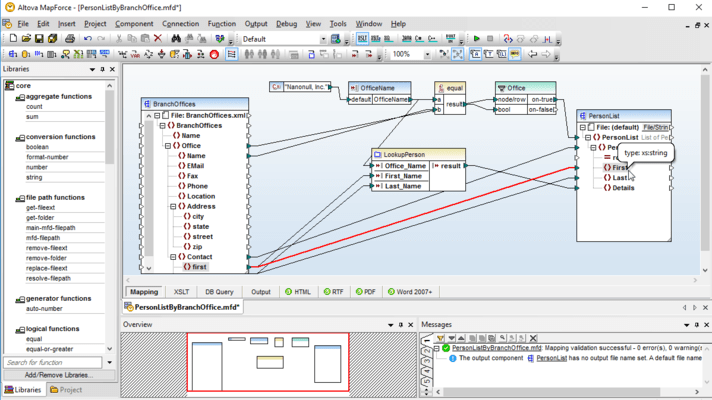
Chained transformations enable users to create complex mappings in which the output of one mapping becomes the input of another. This is a feature that adds to MapForce's ability to execute fully automated transformations. Each chained component becomes a modular entity in an interdependent transformation sequence, allowing for conversions to be made on-the-fly. MapForce users can create chained transformations using any number of mapping components connected to a final target component. Preview and code generation features can be displayed/generated for intermediate components, as well as for the final mapping result. Intermediate mapping components will also now have a "pass-through" button in the title bar. This button will enable users to define the set of data that gets passed on to the following component. - Integration with StyleVision for output components
Integration with StyleVision lets MapForce users automatically render results of their XML and XBRL mappings using an associated StyleVision template design. This means that these components can be previewed as HTML, RTF, PDF, or Word 2007+ documents. This feature for MapForce essentially combines its capabilities with those of StyleVision, meaning that users can now automate report generation from virtually any data format - as long as it can be mapped to an XML Schema or XBRL taxonomy. - Formatting of numbers, dates, and times
One of the most frequently requested features, this enables MapForce users to easily convert numbers, dates, and times to their string representations using a variety of different formatting functions. For example, the simple format-number function below converts a numerical input (e.g., 12345) to a monetary one in with a USD prefix, comma separating the thousands digits, and two decimal places (e.g., $12,345.00). - Two new parameters in auto-number function
The auto-number generator function in MapForce has been updated to include two additional parameters, global-id and restart-on-change, adding to the ways in which you can manipulate data between source and target format(s). Global-id assigns a global identifier to an auto-number sequence, making it accessible throughout the data mapping project, including in user-defined functions. Restart-on-change allows users to restart auto-numbering every time the value supplied this parameter changes, enabling them to create intelligent numbering sequences. - Functions for working with timezones
Two new functions have been added to the MapForce function library to handle mappings that involve timezones. "convert-to-utc" will change time or datetime to a UTC (Coordinated Universal Time) or GMT value, while "remove-timezone" will simply strip the timezone information from a time or datetime conversion. - Extended support for UN/EDIFACT
Support for the EDIFACT international EDI standard has been extended to include 08B, 09A, and 09B messages. - Extended support for ANSI/X12
Support for the X12, the official national EDI standard of the United States of America, has been extended to include the 6010 and 6020 transaction sets.
For more information visit:
http://www.altova.com/Version2011_Launch_090810.html